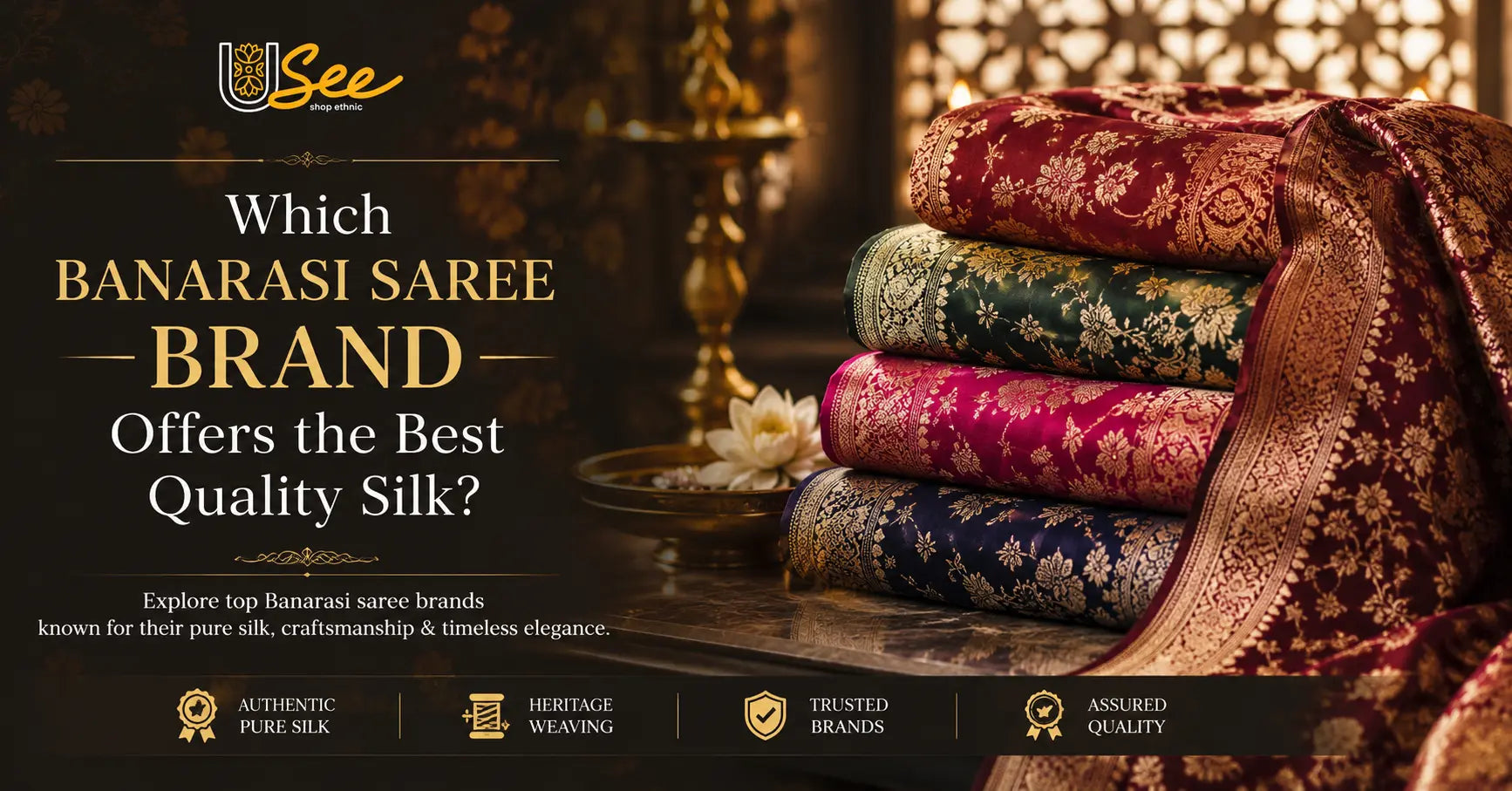
Which Banarasi Saree Brand Offers the Best Quality Silk?
Quick Answer: The best Banarasi saree brand is not about the name, it is about what they can prove. Look for brands that name the exact silk type (Pure Katan, Khaddi Tissue Silk, Mashru Katan), specify the weaving technique, and back it up with Silk Mark or GI certification. That is how you separate authentic from imitation, every single time.
Here is the truth about buying Banarasi sarees online.
You search 'best Banarasi silk saree.' You find 200 options. Every single brand says 'pure silk,' 'handwoven,' 'authentic Banarasi.' And you have absolutely no idea who to believe.
We have spoken to hundreds of customers who have been through exactly this. Sarees that arrived looking nothing like the photos. Fabrics that felt synthetic. Zari that turned dull after one wash. Not because they did not research, but because they did not know what to look for.
That is the problem this guide solves. At The Usee Shop, we source directly from Varanasi weavers, and we have seen firsthand how quality is made, and how it is faked. Here is everything we know, laid out simply so you can shop with confidence.
What Actually Makes a Banarasi Silk Saree High Quality
Most buyers focus on the brand name. That is the wrong place to start.
Quality in a Banarasi saree comes down to three things: the silk variety, the weaving technique, and fabric weight. Understand these three and you can evaluate any brand, any marketplace, any price point. It takes about 30 seconds once you know what to look for.
The Silk Varieties That Define Authentic Banarasi Weaving
Not all Banarasi silk is the same. There is a clear hierarchy, and the better brands will always tell you exactly which type they are using.
-
Pure Katan Silk: The densest and most premium type. Both warp and weft are 100% silk threads. Heavy, firm, and cool to the touch. The go-to for bridal trousseaux and high-occasion Indian ethnic wear.
-
Pure Khaddi Tissue Silk: Silk warp with a fine zari weft. Lightweight, breathable, and absolutely luminous. Perfect for weddings and festive occasions where you want the sheen without the weight.
-
Mashru Katan: A silk-forward construction with a distinctive surface sheen. Deeply prized in Banarasi handloom craft traditions, especially for wedding season pieces.
-
Organza Silk: The lightest option. Translucent, crisp, and great for festive pieces where visual impact is the priority.
If a brand just says 'Banarasi silk' without naming the type, that is a red flag. It is vague on purpose. Explore The Usee Shop's Tissue Silk Saree Collection to see how proper fabric naming looks in practice, every product specifies exactly what you are buying.
Why Weave Construction Tells You More Than the Label Does
This is where real Banarasi sarees separate from the imitations. And most buyers never check it.
Kadhua weaving is the gold standard of Banarasi handloom craft. Each motif is woven individually by hand on a jacquard loom. The result? Clean reverse side with no loose threads, sharp motif definition, and a saree that holds its structure for years. A single kadhua-woven saree with dense zari brocade can take a skilled weaver 15 to 30 days to complete. That labor is what you are paying for.
Cutwork is the faster, cheaper alternative. Floating threads are woven across the surface, then trimmed from the back. It can look impressive upfront but the reverse will show you the truth instantly. Cutwork is not fake. It is just a different price tier. The real problem is when sellers charge kadhua prices for cutwork construction.
Pro Tip: Always ask for a photo of the back of the saree's pallu. A genuine handwoven Banarasi will show natural weave irregularity and pin marks along the selvedge. A machine-made copy will look perfectly flat and uniform.
Fabric weight matters too. A pure Katan Banarasi typically weighs 800 to 1,000 grams. If it feels light and slippery, something is off.
How to Spot Pure Zari Before You Spend a Rupee
Zari is where most brands cut the deepest corners. And it is also the easiest place to spot the difference once you know what you are looking for.
Three Types of Zari and How to Tell Them Apart
-
Pure (real) zari: Silk thread core, coated with real metalwork, traditionally silver with gold electroplating. Glows warmly in natural light. Rich, deep, and never harsh. The sheen shifts as the angle changes.
-
Tested zari: Copper core with a thin metallic finish. Looks attractive at first glance but has a brighter, flatter shine compared to pure zari. Still decent quality at the right price point.
-
Synthetic or imitation zari: Plastic or copper wire base. Looks plasticky, fades fast, and turns dull or grey after a few washes. This is what is used in very low-price Banarasi copies.
Watch the language in product descriptions. 'Real zari' or 'pure zari' with certification backing is credible. 'Golden zari,' 'fancy zari,' or just 'zari work' without any specification is a reason to dig deeper before you buy.
The Usee Shop's Handwork Saree Collection includes close-up photography of both the front and back of key pieces, so you can actually see the zari quality and weave construction before ordering.
Silk Mark and GI Tag: What These Certifications Actually Guarantee
Bottom Line: Silk Mark certifies the fiber is 100% pure silk. The GI tag certifies the saree was made in the Banaras region using traditional handwoven methods. Both together is the gold standard. But neither guarantees kadhua construction or zari quality, so always combine certification checks with the physical checks in this guide.
The Silk Mark Certificate
Issued by the Silk Mark Organisation of India under the Central Silk Board and Ministry of Textiles, the Silk Mark certifies one thing only: the saree contains 100% pure natural silk. Each label carries a coded hologram that traces back to the authorized seller. You can verify it independently.
Important nuance: a Silk Mark certified saree could still use tested zari or cutwork construction. The certificate is for fiber purity, not overall craftsmanship. Use it as one signal among many, not a final verdict.
The Geographical Indication (GI) Tag
Granted in 2009, the GI tag for Banarasi silk certifies origin from the designated Banaras weaving belt, covering Varanasi, Chandauli, Bhadohi, Mirzapur, Jaunpur, and Azamgarh districts. It also certifies adherence to traditional Banarasi handwoven methods. Together with the Silk Mark, it is the strongest authentication a buyer can ask for. Browse The Usee Shop's Pure Silk Collection for pieces with full provenance transparency.
What Prices Actually Signal About Quality
Price is not always reliable on its own. But when you combine it with construction knowledge, it becomes a very useful filter.
Rs. 5,000 to Rs. 15,000: Tissue Silk, Organza, and Entry Banarasi
This is a realistic range for genuine Banarasi tissue silk or organza sarees with simpler designs and lighter zari coverage. These are beautiful, wearable pieces, especially for festivals and family functions.
But if a seller is claiming 'handwoven pure Katan' with heavy brocade and dense zari work at Rs. 4,999, walk away. The math does not work. A Varanasi weaver spending 20 days on a loom cannot produce that for that price.
Rs. 20,000 and Above: Pure Katan and Mashru Katan Territory
This is where authentic handwoven Pure Katan and Mashru Katan sarees with serious zari coverage, multi-colour brocade, and heavy pallu work realistically sit. Mashru Katan in particular commands premium pricing because of its labor-intensive construction and the quality of the silk foundation used. The Mashru Silk Collection at The Usee Shop reflects honest pricing for this tier, pieces priced for what the construction actually cost to make.
How to Check Before You Buy: A Practical Checklist
Buying In-Store
-
Feel the weight: pure Katan should feel substantial, 800 to 1,000 grams for a full saree
-
Hold it to natural light: authentic silk shifts in luminosity as the angle changes, synthetics do not
-
Check the reverse: look for natural weave irregularity, selvedge pin marks, and weave floats at borders
-
Check zari shine: pure zari glows warmly, synthetic zari looks flat and overly bright
-
Ask for Silk Mark and GI tag documentation before finalising
Buying Online
-
Request high-resolution photos of the back of the pallu and the selvedge edge
-
Ask the seller to specify: silk type, weaving technique, and zari type
-
Check if Silk Mark or GI certification is mentioned and verifiable
-
Match the price to the construction being claimed
-
Read customer reviews for mentions of fabric quality, not just aesthetics
The Usee Shop's Designer Saree Collection lists the exact silk type and construction method on every product page, making this checklist straightforward to run through in under a minute.
How The Usee Shop Sources and Curates Its Banarasi Collection
We want to be transparent about how we work, because we think buyers deserve to know.
The Usee Shop sources directly from weavers in the Varanasi handloom belt, the same artisans who have been practicing Banarasi handloom craft for generations. Every fabric type in our collection is named precisely: Pure Khaddi Tissue Silk is not just called 'tissue silk' because the construction (silk warp with fine zari weft) is genuinely distinct from generic blended tissue. Mashru Katan is not just 'silk' because it has a specific multi-technique construction that affects how it drapes, catches light, and holds over time.
When you shop our Pure Khaddi Tissue Silk collection, you are not just buying a saree. You are buying something made on a handloom in Varanasi, by a weaver who knows the difference between kadhua and cutwork, and who takes pride in the craft. We think that matters. And we think you deserve to know it upfront.
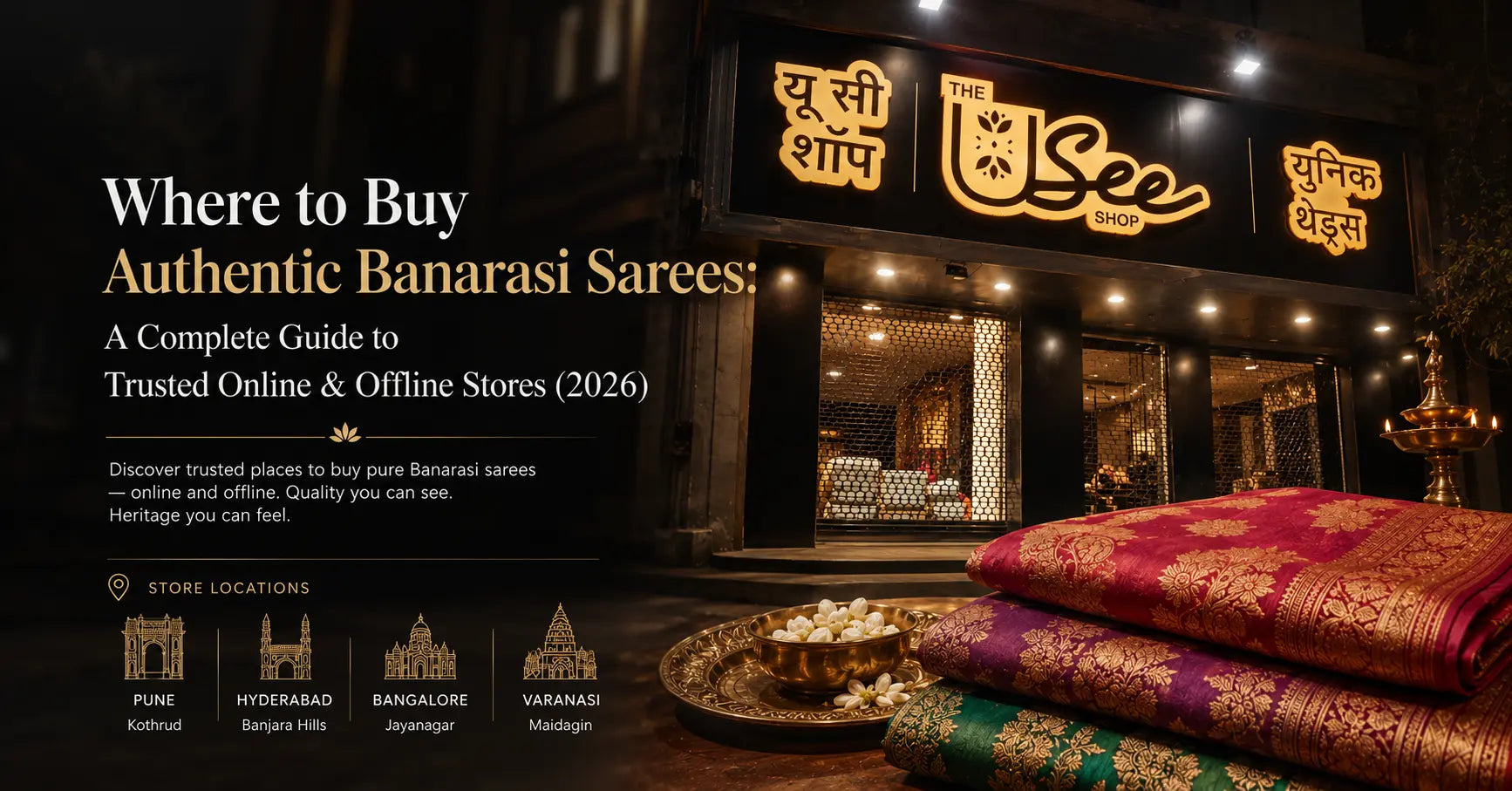
Our retail stores in Varanasi, Bangalore, Hyderabad, and Pune also give you the option to see and feel the fabric in person before buying, something we always encourage for first-time buyers of premium Banarasi silk sarees.
The Short Answer to a Big Question
The best Banarasi saree brand is the one that shows you its work.
It names the silk type. It specifies the weaving technique. It is honest about the price. It provides real documentation. And it stands behind what it sells.
Brand reputation is a starting point, not a guarantee. We have seen well-known names cut corners and small artisan brands produce extraordinary work. What never lies is the fabric itself: the weight in your hand, the way light hits the zari, the weave you can see on the reverse side.
Learn the markers. Apply the checks. And shop from sellers who make it easy for you to do that. Start with The Usee Shop's full Banarasi Saree Collection and see what fabric transparency looks like in practice.
Frequently Asked Questions
What is the most authentic type of Banarasi silk?
Pure Katan silk is the most authentic Banarasi silk type. Both warp and weft are 100% silk threads, giving it maximum weight, density, and the cool drape that defines traditional Banarasi weaving. For buyers who want luminosity with less weight, Pure Khaddi Tissue Silk is the next tier down and equally prized in the Banarasi handloom craft tradition.
How do I check if a Banarasi saree is original?
Flip it over. An authentic handwoven Banarasi saree shows natural weave irregularity, pin marks along the selvedge, and weave floats at the borders. A machine-made copy looks perfectly flat and uniform on the reverse. Also check for Silk Mark certification, ask for the specific silk type name, and verify the price matches the construction being claimed.
What is the price of a genuine Banarasi saree in India?
Genuine Banarasi tissue silk and organza sarees start from Rs. 5,000 to Rs. 15,000 for simpler designs. Authentic handwoven Pure Katan and Mashru Katan sarees with significant zari brocade work range from Rs. 20,000 to Rs. 45,000 and above. Any seller claiming pure handwoven Katan with dense zari under Rs. 5,000 is a red flag.
Which Banarasi saree is best for a wedding?
For the bride and close family, Pure Katan Silk or Mashru Katan are the top choices. They have the weight, richness, and occasion-appropriate presence that Banarasi silk is known for. For wedding guests, Pure Khaddi Tissue Silk is ideal: lightweight, luminous, and easy to wear through a long ceremony without the heaviness of full Katan.
Why are genuine Banarasi sarees expensive?
Because of the labor. A single kadhua-woven Banarasi saree with dense zari brocade takes a skilled Varanasi weaver anywhere from 15 to 30 days to complete on a handloom. Add pure silk fiber costs, real zari thread, and the GI-certified weaving process, and the pricing reflects actual craft value, not marketing inflation.
Does The Usee Shop sell genuine Banarasi sarees?
Yes. The Usee Shop sources directly from Varanasi weavers and specifies the exact silk type and construction on every product, Pure Khaddi Tissue Silk, Mashru Katan, Pure Katan Silk, never just 'silk.' With retail stores in Varanasi, Bangalore, Hyderabad, and Pune, buyers can also verify fabric quality in person before purchasing.

Written by Kreative Catalyst


,%20spe...)
Leave a comment
This site is protected by hCaptcha and the hCaptcha Privacy Policy and Terms of Service apply.