
Where to Buy Authentic Banarasi Sarees: A Complete Guide to Trusted Online & Offline Stores (2026)
Every year, a huge number of sarees get sold as "Banarasi" that have never come anywhere near a Varanasi loom. The market's flooded with power-loom replicas, printed imitations, and synthetic blends dressed up as pure silk. Figuring out where to actually buy an authentic Banarasi saree isn't a matter of luck. It comes down to having the right information before your money changes hands.
This guide walks through every buying channel worth your time in 2026: established Varanasi shops, government-certified outlets, and trusted online platforms, along with how to verify authenticity on the spot, what realistic prices actually look like, and a quick checklist to run through before you pay.
Buying directly in Varanasi: what to know before you go
Shopping in Varanasi itself is the most direct route to a genuine handwoven saree, but it isn't automatically the safest one. The city has extraordinary weavers and heritage manufacturers, sure, but it also has a thriving trade in tourist-facing replicas. Knowing where to go really does make all the difference.
Government emporiums and cooperative showrooms
The UP Handloom Emporium, also called the Government Handloom House, sits in the Gowdoliya area of Varanasi and sells certified Banarasi silk at fixed prices with zero bargaining involved. If you're a first-time buyer who feels uneasy negotiating with private traders, this is about as pressure-free as it gets. The selection is more restrained than what you'd find at a private retailer, but the certification trail is far cleaner. The Banaras Bunkar Samiti, the cooperative that holds the GI registration for Banarasi sarees, is based in Sarnath and is another reliable point of contact for verified sourcing.
The catch for out-of-town buyers
Tourist lanes near Dashashwamedh Ghat and Godowlia are often stocked with lower-quality replicas sold at handloom prices, and pushy selling is genuinely common there. Buyers who don't know the fabric well rarely come out ahead in these settings, and it's worth knowing that guides or auto-rickshaw drivers who "recommend" a specific shop are usually earning commission from that same store. If travelling to Varanasi isn't realistic, or you don't have someone local you trust, a reputable online platform sourced directly from Varanasi weavers is often the smarter, safer route.
Buying authentic Banarasi sarees online, without the guesswork
Online shopping for genuine Banarasi silk has matured a lot in recent years. Buyers outside Varanasi now have access to weaver-direct collections, certified stock, and return policies that plenty of physical tourist-area shops still don't bother offering. The trick is picking the right platform, one that's upfront about sourcing, carries real certification, and actually stands behind what it sells.
What to look for in any online seller
A few non-negotiable signals apply no matter where you're buying. Listings should explicitly mention the GI tag and Silk Mark certification, not just throw around the phrase "pure silk" and hope you don't ask further. Worth knowing: Silk Mark is only issued to authorised sellers, and the GI tag is a regional designation rather than an item-by-item serial number, so it's worth checking whether the seller shows up as a listed authorised user on the Silk Mark Organisation of India's website. Beyond certification, look for a clear, written returns and exchange policy, along with genuine customer reviews or some transparency about weaver sourcing. If a seller can't confirm all three, it's worth walking away, no matter how good the photos look or how tempting the price is.
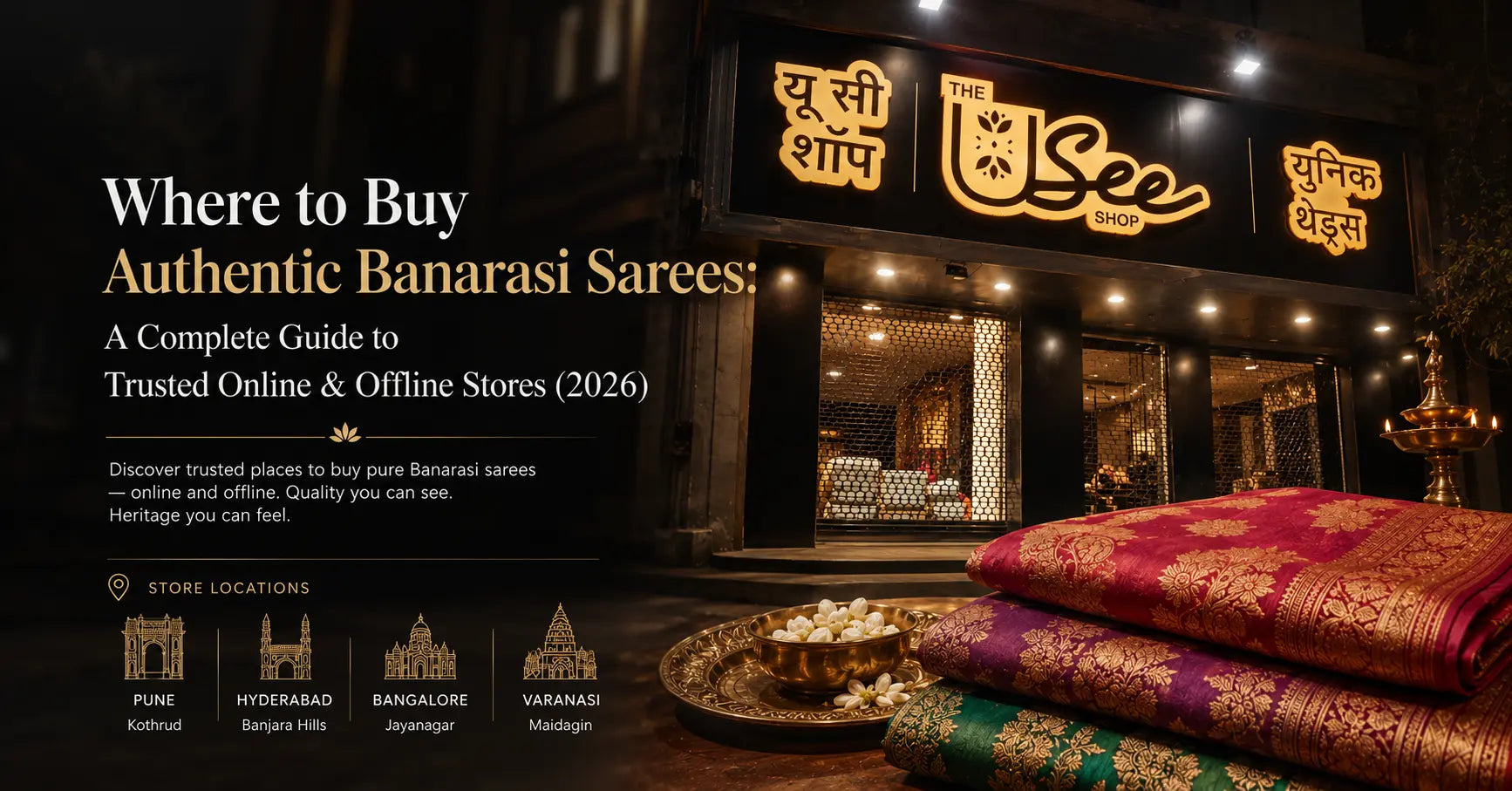
The Usee Shop is rooted in Varanasi's handloom tradition and runs both in-store and online, giving shoppers across India access to authenticated collections without needing to travel. The range spans Pure Katan Silk, Pure Tissue Silk, Georgette, Organza, Chinia Silk, and heavy bridal pieces, each grouped by occasion so a lightweight Organza built for a daytime function doesn't get lost among dense bridal Katans. The site lets you filter by fabric and occasion, so you're not scrolling through hundreds of irrelevant results, and detailed fabric descriptions plus a documented returns policy make it easier to compare options than an unfamiliar Varanasi shop visit often is.
How to tell a genuine handwoven Banarasi from a fake
None of this is complicated once you know where to look. The most reliable clues come from the back of the saree, the actual feel of the fabric and zari, and the certification tags themselves.
What the reverse side tells you
The back of a genuine handwoven saree is one of the most honest indicators you'll find. Handwoven Katan, tissue, and organza pieces all show small floating threads, tiny knots, and slightly uneven work on the reverse, that's just the natural result of a weaver working motif by motif on a pit loom. A power-loom replica, by contrast, has a flat, perfectly uniform back with no loose threads because it's machine-finished start to finish. If the reverse looks suspiciously clean, it almost certainly isn't handwoven.
The touch test, the drape, and the zari rub
Pure silk feels cool against the skin, heavier than it looks, and drapes in slow, fluid pleats rather than bouncing or holding stiff shape artificially. Run the zari between your fingers, genuine silver or gold-coated thread keeps a warm glow even after rubbing. If it dulls, turns grey, or feels plasticky, that's synthetic. The selvedge on a handwoven piece also shows slight unevenness and tiny pinholes from where it sat on the loom. A perfectly smooth, machine-straight edge is a power-loom giveaway every single time.
GI tag and Silk Mark: what they actually certify
The Banarasi saree has carried a Geographical Indication tag since 2009, confirming the weave genuinely originates in Varanasi. The Silk Mark is a separate label from the Central Silk Board, administered through the Silk Mark Organisation of India, certifying that the fabric is 100% natural silk. A genuine Silk Mark label carries five tamper-proof features: the butterfly logo, a hologram, a unique alphanumeric serial number, a scannable QR code linking to the authorised seller, and a sticker that self-destructs if someone tries to remove it. You can verify a seller's status directly on the SMOI website, and a legitimate seller should be able to produce both certifications on request without hesitating.
What a real Banarasi saree actually costs in 2026
Price is honestly one of the clearest signs of authenticity in this category. Genuine Banarasi sarees are never cheap to make, and knowing realistic ranges protects you both from overpaying and from falling for an offer that's too good to be real.
Pure Katan Silk bridal sarees
Pure Katan Silk is the most prized weave in the entire Banarasi tradition. In 2026, expect to pay somewhere between ₹19,999 and ₹50,000 for a genuine handwoven Katan bridal saree, with heavily worked, dense zari-brocade pieces going well beyond that. If someone quotes you ₹8,000 for "pure Katan," it simply isn't pure Katan. A single heavy-brocade piece can take 240 or more hours of focused weaving across a team of three weavers, and pure silk yarn combined with gold-coated zari adds real cost on top of that labour. Pricing below ₹19,999 for a genuine piece is close to impossible.
Everyday weaves and lighter fabrics
When choosing a Banarasi saree for a wedding or special occasion, understanding the price range of different weaves can help you make a better decision. Whether you're exploring The Pune Saree Guide: Bridal Silks, Organza Festive Styles or shopping from anywhere in India, knowing the value of each fabric helps you invest in an authentic saree. Handwoven Georgette and Khaddi Georgette Banarasi sarees, known for their lightweight drape and versatility, are typically priced between ₹4,999 and ₹15,000, making them suitable for festive occasions as well as office wear. Pure Tissue Silk and Organza Banarasi sarees, popular for daytime weddings, receptions, and elegant celebrations, generally range from ₹10,000 to ₹32,000, depending on the richness of the zari work and craftsmanship. Chinia Silk Banarasi sarees fall somewhere in the middle, offering an authentic Banarasi look and feel at a more accessible price than premium Katan silk. As a general rule, if a saree is marketed as "Pure Banarasi Silk" for well under ₹5,000, it is likely to be a synthetic blend or a machine-made imitation rather than a genuine handwoven Banarasi saree.
Comparing your buying channels, and a quick checklist
|
Buying Channel |
Authenticity |
Certification |
Price Range |
Convenience |
Returns |
|
Varanasi private heritage shops |
High, if you know the shop |
Usually on request |
₹5,000–₹50,000+ |
Requires travel |
Varies, not always documented |
|
Varanasi government emporium |
High, fixed price, certified |
GI tag and Silk Mark standard |
Fixed, mid-to-premium |
Requires travel |
Limited, fixed-price policy |
|
Multi-brand retail chains |
Moderate, brand-dependent |
Silk Mark on select lines |
Mid-to-premium |
Good in metros |
Generally available |
|
Established online-only sellers |
Variable, check listings |
Inconsistent |
Wide range |
Excellent |
Varies significantly |
|
The Usee Shop |
High, direct weaver sourcing |
GI tag and Silk Mark across collections |
₹4,999–₹50,000+ |
Excellent, pan-India |
Clear returns and exchange policy |
Seven-point authenticity checklist:
-
Check the reverse for floating threads and small knots, the natural mark of a pit loom.
-
Feel the weight: pure silk is noticeably heavier than it looks and cool to the touch.
-
Rub the zari between your fingers; genuine gold or silver thread holds its glow.
-
Inspect the selvedge for slight unevenness and pinholes from the loom.
-
Confirm the GI tag is present, certifying Varanasi origin.
-
Confirm the Silk Mark and check the QR code or serial number on the SMOI website.
-
Weigh the price against the realistic 2026 range for that fabric. If it seems too good to be true, it is.
FAQs
1. Where can I buy authentic Banarasi sarees in India?
Authentic Banarasi sarees can be purchased from trusted Varanasi-based retailers, government handloom emporiums, certified online stores, and brands like The USee Shop that source directly from Varanasi weavers.
2. How do I verify if a Banarasi saree is genuine?
Check for Silk Mark certification, GI Tag support, handwoven irregularities, genuine zari work, and detailed product information. Buying from trusted sellers further reduces the risk of imitation products.
3. Is it safe to buy Banarasi sarees online?
Yes. Choose sellers that provide certification details, transparent return policies, verified customer reviews, and clear information about fabric, weaving techniques, and sourcing.
4. What is the average price of an authentic Banarasi saree?
Handwoven Banarasi sarees generally start around ₹5,000 for lighter weaves, while premium Katan Silk bridal sarees can range from ₹20,000 to over ₹50,000 depending on craftsmanship and zari work.
5. What is the difference between a GI Tag and a Silk Mark?
A GI Tag confirms the Banarasi saree originates from the Varanasi region, while a Silk Mark certifies that the fabric is made from 100% natural silk.
6. Why choose The USee Shop for Banarasi sarees?
The USee Shop offers authentic Banarasi sarees sourced from Varanasi weavers, featuring certified silk, transparent product details, multiple fabric options, and reliable online shopping with nationwide and international delivery.

Written by Kreative Catalyst



Leave a comment
This site is protected by hCaptcha and the hCaptcha Privacy Policy and Terms of Service apply.