

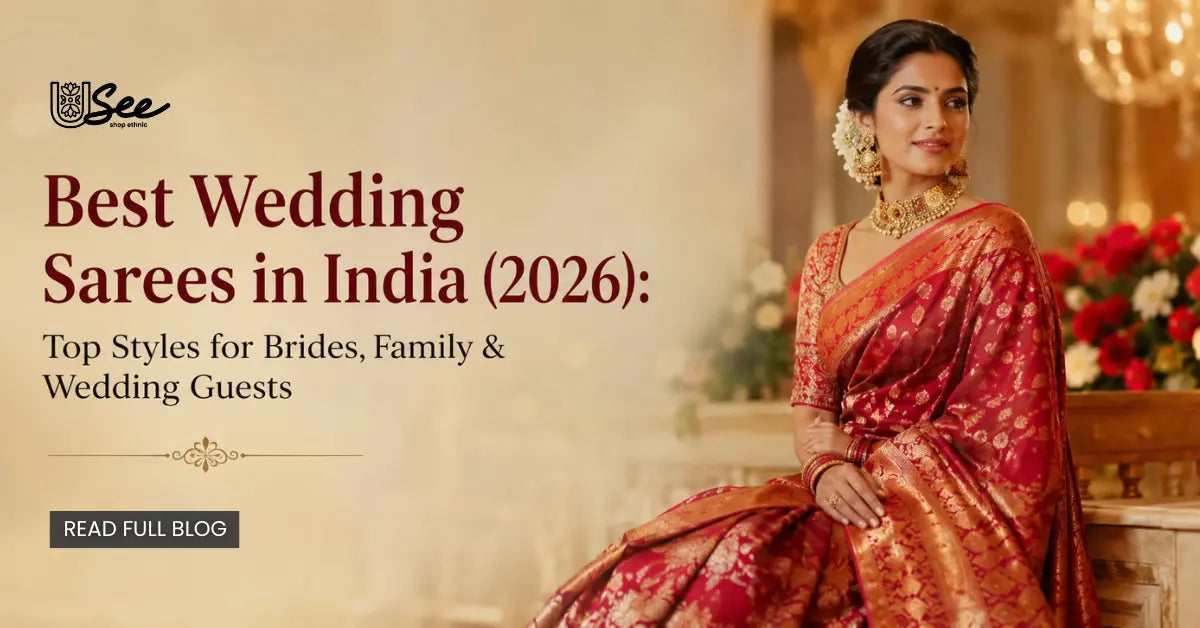
Best Wedding Sarees in India (2026): Top Styles for Brides, Family & Wedding Guests
Picking the best wedding saree is genuinely one of those decisions that looks simple until you're actually in it. You're staring down hundreds of options across fabrics, colours, weaves, and price points, the wedding date is getting closer by the day, and your budget definitely isn't infinite. Here's the reassuring part, though: the best wedding sarees aren't necessarily the heaviest or the most expensive ones in the shop. They're the ones that match your role, your event, and how you actually want to look in photographs twenty years down the line. At The Usee Shop, rooted in Varanasi's weaving tradition for generations, we've walked thousands of brides, mothers, and guests through exactly this decision. So here's a practical framework for the whole thing, from picking the right fabric to knowing where you can buy with actual confidence.
First question: what's your role at this wedding?
Before you even start looking at colours or fabrics, be honest with yourself about your role. What your saree needs to do is completely different depending on whether you're the bride, the mother of the bride, or a guest who just wants to look good in the background. Get this part right first and everything else moves faster.
The bride, when your saree is the whole point of the day
A bridal saree has two jobs, really: look stunning, and survive an entire day of ceremony without becoming unbearable. Photographs get looked at for decades, so how it holds up on camera matters a lot too, but that mostly takes care of itself once you've picked the right fabric. For 2026 brides, Banarasi Katan Silk, Kanjeevaram (pattu), and Paithani remain the gold standard for the main ceremony. These fabrics hold a structured drape under camera lights, carry real cultural weight, and belong in that small category of things you keep forever instead of wearing once.
The colour story has genuinely shifted too. Classic reds and maroons still rule North Indian weddings, but blush pink, powder blue, ivory, and champagne are now real bridal choices, not just experiments. South Indian brides are mostly staying loyal to arakku red, maroon, and emerald green for Kanjeevaram, though a few are quietly reaching for muted lavender or ivory to stand a little apart.
Mother of the bride and close family
The balance here is dressing beautifully without ever competing with the bride. Mid-weight fabrics like Tissue Silk, Chinia Silk, and Georgette with refined zari borders hit this exactly right. Coordinating loosely with the wedding palette is a nice touch too, it photographs well in family portraits and doesn't require sending out a formal colour brief to everyone.
Wedding guests and bridesmaids
Lighter fabrics work best here: Organza, Georgette, and Mashru Silk give you elegance without tipping into the kind of formality that competes with the bride. One rule still holds firm, skip heavy bridal red or ivory entirely. The best wedding sarees for guests lean toward jewel tones and contemporary embroidery, and bold yellows, deep pinks, and peacock blue all work beautifully. Reception looks for guests follow the same logic: go a little more vivid, keep it lighter, and let the bride hold the bigger statement.
Fabrics worth knowing before you buy
Understanding fabric is probably the single most useful thing you can walk into a saree purchase with. Weight, drape, and sheen all shift depending on fabric, and so does the price tag.
The heavyweights: Banarasi Katan and Chinia Silk
Banarasi Katan Silk is the gold standard of North Indian bridal wear, dense, lustrous, with a stiffness that holds its drape beautifully no matter the lighting. It's tied deeply to Varanasi's weaving tradition, which is exactly why authentic Katan sits at the heart of most bridal collections, including the pure Katan silk range many brides come back to for heirloom pieces. Chinia Silk is a touch lighter and smoother, a good choice if you want real silk richness without carrying the full weight of a Katan through an entire ceremony day. Both belong firmly in the bridal and close-family tier.
Lighter options: Tissue Silk, Organza, Georgette, Mashru, and Satin
Tissue Silk catches light like nothing else. That metallic shimmer photographs beautifully in both natural and artificial light, which makes it a favourite for evening ceremonies and for mothers who want to look luminous in family photos. Organza gives you an almost fairy-like drape, perfect for engagement functions or day ceremonies. Georgette moves naturally with the body, which is exactly why it's the go-to for sangeet and reception nights where dancing is involved. Mashru Silk blends the sheen of silk with the breathability of cotton, making it a smart pick for long outdoor weddings.
|
Fabric |
Weight |
Best occasion |
Price tier |
Photography |
Care |
|
Banarasi Katan Silk |
Heavy |
Main ceremony, bridal |
Mid to premium |
Excellent, holds drape on camera |
Dry clean only |
|
Kanjeevaram (pattu) |
Heavy |
Main ceremony, bridal |
Premium |
Excellent, bold borders photograph well |
Dry clean only |
|
Tissue Silk |
Medium |
Evening ceremonies, family |
Mid-range |
Outstanding, metallic shimmer in any light |
Gentle hand wash or dry clean |
|
Organza |
Light |
Engagement, day functions |
Entry to mid |
Very good, flowy and luminous |
Gentle hand wash |
|
Georgette |
Light |
Sangeet, reception |
Entry to mid |
Good, fluid movement on camera |
Easy, hand wash or gentle machine |
|
Mashru Silk |
Light to medium |
Outdoor, summer weddings |
Mid-range |
Good, soft sheen in natural light |
Gentle hand wash |
|
Satin |
Medium |
Formal receptions |
Entry to mid |
Moderate, reflective but can look flat |
Dry clean recommended |
Keep this table handy while comparing options across your budget tiers.
Matching your saree to the actual event
A modern Indian wedding is rarely just one event, most run across three to five ceremonies over several days, and wearing the wrong fabric to the wrong function is a completely fixable mistake once you understand the logic behind it.
The main ceremony, whether it's a Hindu ceremony, Nikah, or church wedding, is where Banarasi Katan Silk, Kanjeevaram, and Paithani stand out without much competition. These fabrics hold structure, catch light naturally, and carry the visual weight the most photographed moment of the day deserves. One detail brides are leaning into for 2026: pairing statement borders in contrast shades, red with gold, ivory with emerald, for a sharper photographic edge that reads well even in candid shots.
Sangeet, Mehendi, and engagement functions are all about movement, so fabric weight directly affects how comfortable you are on the dance floor. A heavy Katan or Kanjeevaram will slow you down fast; Georgette, Crepe, and Organza genuinely belong here instead. Lighter fabrics also open the door to more playful colours, bold yellows, deep pinks, turquoise, that suit pre-wedding energy far better than heavy ceremonial silk. If your Mehendi or engagement is a daytime affair, muted pastels and soft pinks photograph especially well in natural light.
The reception is really your second showcase moment. 2026 reception looks lean toward designer sarees in net, organza, and satin with heavy embroidery or stonework. This is also where ready-to-wear draping styles genuinely earn their place, especially for brides who've already carried a heavy traditional saree through the main ceremony. A lighter second saree lets you actually move through the reception dinner and still photographs beautifully indoors.
What your budget actually gets you
Most people hit the same wall here, they can't tell if a price is fair or not. So here's an honest breakdown across three tiers.
Entry level: ₹1,000 to ₹11,000, Georgette, basic silk blends, and chiffon with minimal zari or embroidery. Genuinely fine for guests, sangeet functions, or gifting, and the quality in this range has improved a lot as online curation has gotten better. Don't write this tier off just because it's affordable.
Mid-range: ₹11,000 to ₹50,000, This is where the quality jump becomes obvious. Pure Banarasi Katan Silk with real zari, Tissue Silk with genuine metallic weave, and well-made Organza designer sarees all live here. For mothers and close family, this tier gives you the best balance of quality and value. Brides on a considered budget can often find real Varanasi craftsmanship near the top of this bracket, particularly between ₹10,000 and ₹16,500 from verified handloom sources.
Premium and heirloom: ₹50,000 and above, Heavy Kanjeevaram, pure Katan with meenakari work, and luxury handloom bridal pieces sit here. These aren't just outfits, they're heirlooms meant to be passed down. What separates genuine craftsmanship from overpriced mass production is the actual weight of real zari (not metallic-coated thread), how dense and even the weave is, and whether it carries Silk Mark or GI certification. At this price, always ask for authenticity documentation before you pay.
Making sure what you buy is real
Genuine Banarasi craftsmanship has a few specific markers: real zari rather than metallic thread coated in gold paint, small hand-woven irregularities on the reverse side that machines simply can't replicate, and a weight that reflects how dense the weave actually is. Silk Mark certification and the GI tag are the two things every bridal saree buyer should ask for, especially when buying online. The Silk Mark tag carries a butterfly logo, a holographic strip, and a serial number you can actually verify on the Silk Mark Organisation of India's website.
The Usee Shop was founded in Varanasi, the heartland of Banarasi weaving, and that isn't just a nice detail in an about page, it means the collection is sourced directly from the weavers and workshops that define this craft, without three layers of resellers sitting in between. The range covers pure Katan Silk, Tissue Silk, Organza, Chinia Silk, Mashru Silk, Georgette, and Satin, spanning budget-friendly to properly luxury, so every role at a wedding is covered without needing five different websites. You can shop the physical stores across India or browse everything online, and international shipping is available for NRI shoppers in the US, UK, Canada, or Australia.
The demand for pre-stitched, ready-to-wear bridal sarees has grown a lot too, mostly among brides who'd rather not spend their wedding morning anxiously pinning pleats. The good news is that ready-to-wear doesn't mean compromising on fabric, you can pick genuine silk and designer sarees in pre-stitched formats that drape correctly every single time, which is a real relief for busy brides or anyone without a regular saree draper on hand.
Looking after your saree, before and long after the wedding
A bridal saree is a financial investment, and often an emotional one too. How you store and handle it before and after the wedding decides how well it survives the years ahead.
Storage, Heavy silk bridal sarees need to be stored flat, folded gently, and wrapped in muslin or pure cotton. Skip plastic bags entirely; plastic traps moisture and that leads straight to mildew and brittle fibres over time. Slide acid-free tissue paper between the folds to protect the zari from friction, and use silica gel, neem leaves, or cedarwood as natural pest deterrents. Naphthalene balls are a common choice but honestly a poor one, they chemically damage silk over time and leave a smell that doesn't go away easily. Refold the saree every three to six months so the crease lines don't become permanent.
Steaming and pressing, Dry cleaning is the safest route for heavy Katan or Kanjeevaram, and for anything above ₹50,000, it's strongly worth it over ironing at home. If you do have to press at home, use the silk setting only, iron on the reverse side with a thin cotton cloth as a buffer, and go easy on the steam rather than pressing down with the iron's full weight. Direct contact between hot metal and zari turns it black, and that damage doesn't reverse. And never spray perfume directly onto the silk, mist it on your skin and let it dry first.
Making the choice with a little more confidence
The best wedding sarees are the ones that suit your role and your ceremony, not necessarily the heaviest weave in the shop or the priciest listing online. Start with your role, match the fabric to the event, be honest about your budget tier, and then focus on where the saree actually came from.
The Usee Shop brings all of this together in one place, authentic Banarasi heritage rooted in Varanasi, a genuinely wide fabric range from Georgette and Organza to pure Tissue Silk, pricing across every tier, and the option to shop in person across India or online from anywhere in the world. Whether you're a bride choosing an heirloom, a mother looking for something refined, or a guest who just wants to look her best without stealing focus, the right saree really is a findable thing. You've got everything you need now to go find it.
FAQ:-
1. How far in advance should I buy a wedding saree?
It's best to buy your wedding saree at least 4–8 weeks before the ceremony. This gives you enough time for blouse stitching, alterations, accessory planning, and any unexpected adjustments. Shopping early also gives you access to a wider selection of authentic handloom sarees before popular designs sell out.
2. Can one premium wedding saree be styled differently for multiple wedding functions?
Yes. A well-chosen saree can be styled for different events simply by changing the blouse, jewellery, hairstyle, and draping style. For example, a Banarasi Tissue Silk or Organza saree from The Usee Shop can look elegant for an engagement with minimal accessories and equally festive for a reception with statement jewellery.
3. What should I check before buying an expensive Banarasi wedding saree online?
Before making a purchase, verify the fabric details, craftsmanship, authenticity certifications (such as Silk Mark or GI certification where applicable), return policy, and seller reputation. Buying from trusted brands like The Usee Shop, which sources directly from Varanasi's weaving tradition, gives buyers greater confidence in the authenticity and quality of their saree.
4. Which wedding saree fabrics are the easiest to wear for long ceremonies?
For events that involve several hours of sitting, walking, and photography, lightweight fabrics like Organza, Georgette, Mashru Silk, and Tissue Silk offer better comfort than heavier bridal weaves. They provide an elegant appearance while allowing easier movement throughout the celebration.
5. How do I choose a wedding saree that won't go out of style?
Focus on timeless craftsmanship rather than short-term fashion trends. Classic Banarasi weaves, elegant zari work, and versatile colours remain fashionable for years and can even become family heirlooms. Investing in traditional craftsmanship ensures your wedding photographs continue to look elegant decades later.
6. Why do many brides and families prefer shopping directly from Varanasi-based saree brands?
Varanasi is globally recognised for its Banarasi weaving heritage. Brands like The Usee Shop work closely with traditional weaving communities, offering authentic craftsmanship, a wider variety of genuine Banarasi fabrics, and better transparency about sourcing than many generic marketplaces. This helps buyers invest in sarees that combine heritage, quality, and long-term value.

Written by Kreative Catalyst


Leave a comment
This site is protected by hCaptcha and the hCaptcha Privacy Policy and Terms of Service apply.