

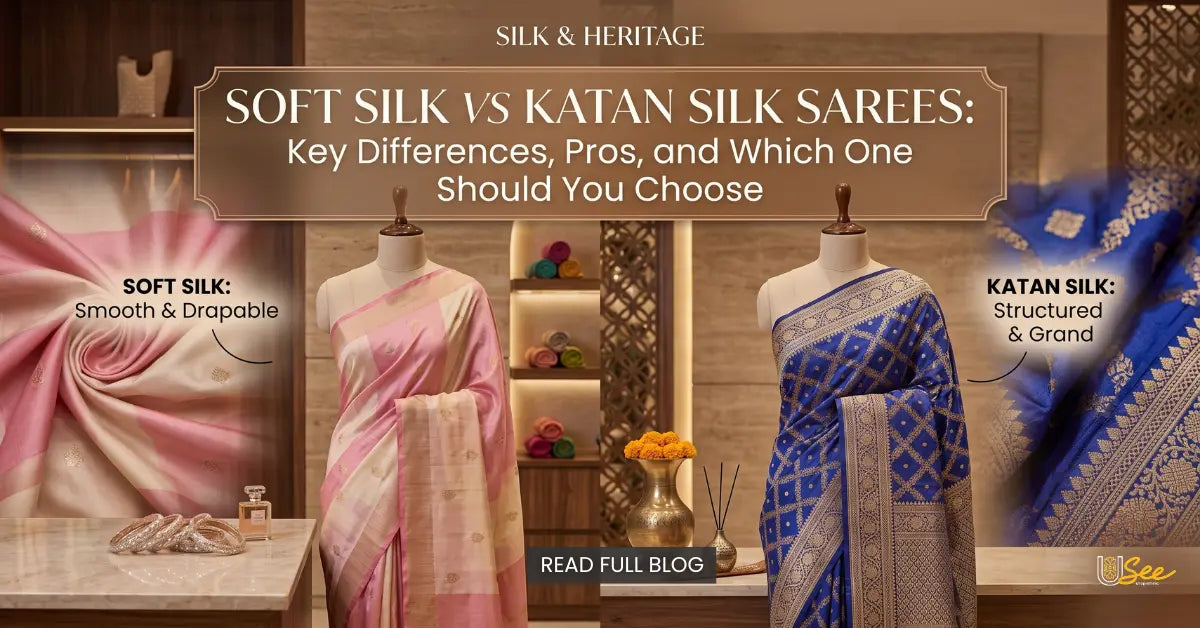
Soft Silk vs Katan Silk Sarees: Key Differences, Pros, and Which One Should You Choose?
You're scrolling through sarees online, and two listings stop your thumb. One says "Pure Banarasi Katan Silk" at ₹25,000. Right below it sits a glossy, butter-soft saree tagged "pure silk" at ₹6,500. Both look gorgeous on screen. Both claim to be silk. If you've ever stared at two tabs like this wondering which one's actually worth the money and which suits your event, you're nowhere near alone. It's one of the most common questions saree buyers bring to us, season after season.
The truth is, "soft silk," "satin silk," and "Katan silk" get thrown around loosely by sellers at every price point, and a photograph will never really tell you what a fabric feels like in your hands. At The Usee Shop, rooted deeply in Varanasi's handloom tradition, we've watched this exact confusion play out again and again. It almost always comes down to one thing: not knowing what separates these two fabrics at the level of the actual thread.
By the end of this, you'll understand how each fabric is made, how to tell them apart by touch and sight, which occasions genuinely call for which, and what a fair price actually looks like. There's no single "better" fabric here. There's only the right one for what you need.
What actually separates these two fabrics, at the foundation
How Katan silk is made: twisted threads, plain weave
Katan silk is defined by its thread structure, not just by the fact that it's silk. Two or three pure mulberry silk filaments get tightly twisted together into a high-ply yarn, then woven in a plain, tabby weave, threads crossing simply over and under each other. That combination gives you a dense, structured, durable fabric with a natural lustre that shifts depending on the angle you're looking from, and one that actually gets richer with age and wear. This is the backbone of authentic Banarasi Katan weaving, a craft Varanasi's handloom workshops have practised for centuries.
Soft silk and satin silk: a lighter, glossier philosophy
"Soft silk" is really an umbrella term covering satin silk, Dola silk, and other mulberry-silk-based fabrics woven purely for comfort and flow. Instead of Katan's twisted yarn, these use minimal-twist or untwisted filaments in a satin weave, where threads run in long floats, over four warp threads, under just one, to maximise how much light bounces off the surface. What you get is a softer, more fluid fabric with a mirror-like gloss, but noticeably less structural weight than Katan. Here's the part that trips people up: both fabrics can genuinely be 100% mulberry silk. It's the yarn twist and the weave construction that make them behave so differently once you're actually wearing them, not the fibre itself.
Drape, weight, and shine, in real life
Weight and texture
The weight difference hits you immediately. Genuine Katan silk usually sits around 700 to 900 grams, while soft and satin silk sarees fall closer to 400 to 500 grams. Katan feels firm and smooth, a little stiff when it's new, and softens beautifully as you wear it over time. Soft silk, on the other hand, feels buttery and fluid from the very first drape. Neither one is better, they just serve different needs entirely. Katan's dense weave also wrinkles far less than satin does, which genuinely matters during a long ceremony when re-draping mid-event isn't an option.
Structured formality vs. fluid flow
Katan holds its shape and forms crisp, well-defined pleats that give a regal, formal silhouette, which is exactly why it's the fabric of choice for grand weddings and heavy zari work. Soft and satin silks move with the body instead, creating a relaxed drape that's genuinely forgiving across different body types and comfortable for long wear. If you drape your own sarees, Katan's structure makes pinning and pleating fairly straightforward, while satin's slipperiness takes a bit more practice to manage neatly.
Natural lustre vs. mirror gloss
Katan carries a warm, natural lustre that shifts and reflects light from multiple angles, and genuinely deepens over time. Satin delivers a high-gloss, uniform shine that photographs beautifully but can look a little flat or artificial under direct indoor lighting. A lot of buyers assume glossier automatically means better quality, and honestly, that's one of the most common misconceptions in the whole saree market. Shine comes from weave structure, not from purity or craftsmanship.
How to spot genuine Katan silk before you buy
By touch and sight
Genuine Katan feels cool and smooth against your skin, never slippery. When it's draped, it makes a subtle rustle that synthetic imitations just don't have. Flip the saree over and check the back: on an authentic handloom piece, you'll see small weave irregularities, tiny knots, and floating threads. These aren't flaws, they're proof the piece was actually handwoven. As for the zari, real zari carries a warm, distinctive sheen and shows a copper core if you pull out a single thread. Imitation zari flakes, feels rough, or takes on a grey or reddish tint when you rub it.
Certifications and the burn test
Two certifications give you the most reliable assurance: the Silk Mark label, confirming 100% natural silk, and the GI Tag, confirming genuine Banarasi origin from one of the six designated districts of Uttar Pradesh, Varanasi included. For a physical check, the burn test works well, pull a single loose thread, burn it carefully, and watch closely. Pure silk burns slowly, smells like burning hair, and leaves a crushable ash. Synthetic fibres burn fast, smell like melting plastic, and leave a hard little residue behind. Only ever try this on a loose thread, never on the saree itself.
A few myths worth letting go of
Glossy doesn't mean pure, satin's shine is structural, not a mark of superior quality. On pricing, while certified handwoven Katan generally costs noticeably more than powerloom blends, entry-level authentic pieces with Silk Mark certification can actually be found from around ₹8,000 upward, so verifying the Silk Mark and GI Tag matters more than treating any single price point as your benchmark. And not every saree labelled "Banarasi silk" is the same product. Powerloom blends and pure handloom Katan are fundamentally different fabrics, even when they sit side by side at similar prices online. If something's labelled "pure Katan" at ₹3,000 or ₹4,000, take that as a serious red flag.
Which fabric actually suits which occasion
When Katan is the right call
Katan is genuinely unmatched for formal wedding ceremonies, especially winter weddings, bridal and reception wear, traditional pujas, and any event where heavy zari work belongs. The weight keeps the fabric in place through long ceremonies, the natural lustre plays beautifully off gold zari, and the structured drape photographs exceptionally well in traditional settings. It's also a real heirloom fabric, a well-kept Katan silk saree routinely gets passed down across generations, which is genuinely part of its appeal for collectors and families alike.
When soft or satin silk makes more sense
Soft silk earns its place at summer weddings and daytime events, where the lighter weight makes a real difference once the heat sets in. For long-wear nights like sangeet or mehndi, the fluid drape cuts down on fatigue considerably. Travelling for a destination wedding? At nearly half the weight of Katan, packing gets a lot easier, and the fabric bounces back well from folding. Satin silk works especially well for receptions and engagement parties, where that mirror gloss photographs beautifully. If you're buying your very first saree, or you just find heavier fabrics uncomfortable, soft silk is genuinely the smarter place to start, elegant, without any of Katan's physical demands.
Price, durability, and care: what to know before you spend
The price gap, explained
As of 2026, authentic handwoven Katan silk typically starts around ₹8,000 to ₹12,000 for entry-level certified pieces, with mid-range options running ₹13,000 to ₹30,000, and premium or designer pieces reaching ₹75,000 to over ₹1,00,000. Soft silk sarees are far more accessible, generally starting around ₹4,999 and rising to ₹10,000 or ₹15,000. What actually drives Katan's price up? The purity of the mulberry silk, the sheer labour of handloom weaving, how much zari is used and its quality, how intricate the motifs are, and which weaver made it, all of that stacks up. Use price as one filter among several, but always pair it with Silk Mark and GI Tag verification, especially when you're buying online.
Care and storage
For Katan, dry cleaning is strongly preferred given how much zari is usually involved. If you must wash at home, use lukewarm water and a mild detergent, and never wring or twist the fabric. Store it wrapped in breathable muslin, never plastic, and refold it every three to six months so the creases don't set permanently. During monsoon, silica gel packs in the storage box will protect the zari from moisture damage. Soft and satin silk are more forgiving, gentle handwashing is generally fine, and the same storage principles apply, just with a little less urgency since zari tends to be minimal. For both fabrics, keep them away from direct sunlight, metal hangers, and any perfume or deodorant sprayed straight onto the cloth.
|
Feature |
Katan Silk |
Soft / Satin Silk |
|
Weave type |
Plain (tabby) weave |
Satin weave, long floats |
|
Thread structure |
High-ply, tightly twisted |
Low-ply, minimal twist |
|
Weight |
700–900 g, heavy |
400–500 g, light to medium |
|
Drape |
Structured, crisp pleats |
Fluid, flowing, forgiving |
|
Shine |
Natural, warm, multi-angle |
Mirror-like, high gloss |
|
Durability |
Very high, heirloom quality |
Moderate, prone to snagging |
|
Best occasions |
Formal weddings, bridal, winter ceremonies |
Receptions, summer events, travel |
|
Price range |
₹8,000–₹1,00,000+ |
₹4,999–₹15,000 |
|
Care |
Dry clean preferred, muslin storage |
Gentle wash acceptable |
Finding the real thing at The Usee Shop
The Usee Shop carries a carefully curated range of authentic, handcrafted Banarasi Katan Silk sarees for weddings, festivals, and everything in between. Browse by fabric, occasion, or budget online, or visit a retail store if you'd rather feel the difference for yourself before deciding. Beyond Katan, the shop also carries Tissue Silk, Georgette, Organza, and Mashru Silk, so whichever direction you end up going, it's one trusted place with genuine Banarasi craftsmanship at its centre.
FAQs
1. What is the difference between Soft Silk and Katan Silk sarees?
Katan Silk is woven from tightly twisted mulberry silk yarns using a plain weave, making it heavier and more structured. Soft Silk uses a satin-style weave, creating a lighter, smoother, and more fluid drape.
2. Which is better for weddings: Soft Silk or Katan Silk?
Katan Silk is ideal for bridal wear, traditional weddings, and grand ceremonies due to its rich texture and heirloom quality. Soft Silk is better suited for receptions, daytime weddings, and long events where comfort is important.
3. How can I identify an authentic Katan Silk saree?
Look for Silk Mark certification, GI Tag support, genuine handloom irregularities, real zari work, and purchase from trusted Banarasi retailers like The USee Shop.
4. Why is Katan Silk more expensive than Soft Silk?
Katan Silk requires premium mulberry silk, tightly twisted yarns, skilled handloom weaving, and often features intricate zari work, making it more labor-intensive and valuable.
5. Is Soft Silk made from real silk?
Yes. Genuine Soft Silk can be made from 100% mulberry silk. However, many products in the market use blended or synthetic fabrics, so checking certifications and product details is essential.
6. Which saree is easier to wear and maintain?
Soft Silk is lighter, easier to drape, and more comfortable for long hours. Katan Silk offers superior durability and structure but generally requires dry cleaning and careful storage.
Final thoughts
Choosing between soft silk and Katan silk really comes down to occasion, budget, and how you plan to wear it. Go with Katan if you're dressing for a formal wedding ceremony, want a heritage-quality piece, or you're investing in something built to last decades. Go with soft or satin silk if comfort through a long event matters more, you're shopping for a summer or daytime occasion, or you want elegance without the extra weight.

Written by Kreative Catalyst


Leave a comment
This site is protected by hCaptcha and the hCaptcha Privacy Policy and Terms of Service apply.