
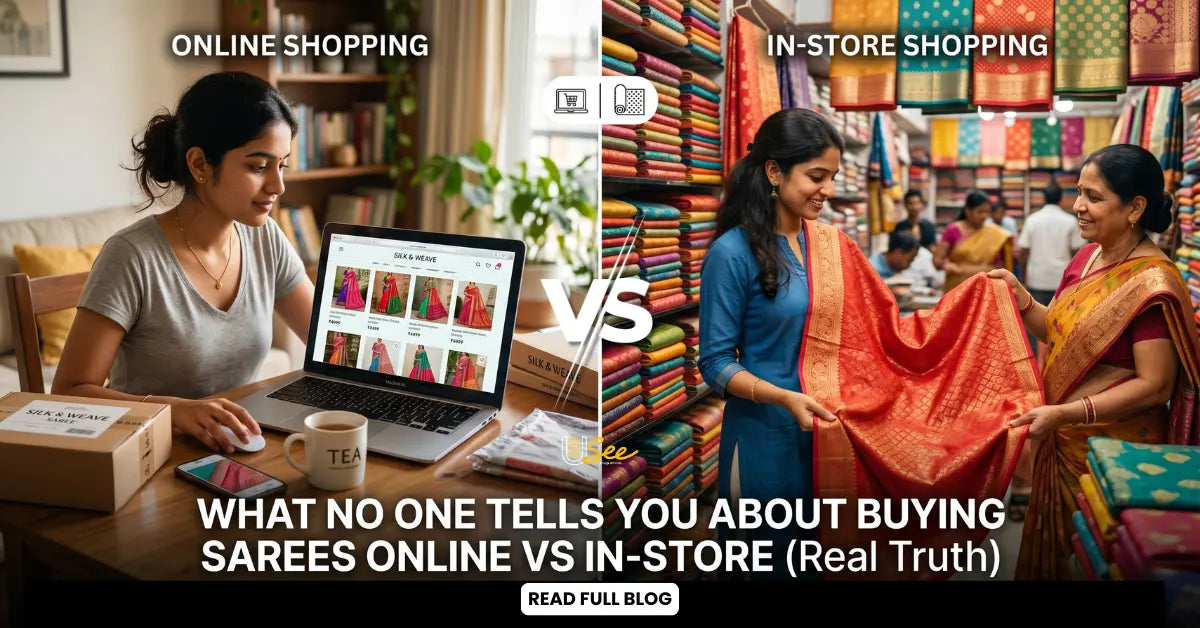
What No One Tells You About Buying Sarees Online vs In-Store (Real Truth)
There’s a pattern most saree buyers don’t notice, but almost everyone follows.
You don’t just wake up and decide, “I’ll buy a saree today.”
It starts somewhere else.
Maybe you saw someone wearing a saree at a function. Maybe it was on Instagram. Maybe you just realised you need one for an upcoming event.
So you start browsing.
At first, it’s casual. You scroll, save a few designs, maybe check prices. Then slowly, it turns into a decision.
And that’s where things get confusing.
Should you order online?
Or should you go to a store?
Most people think this is a simple choice. It isn’t.
Because what no one tells you is that both options come with trade-offs, and most of the time, the mistake isn’t where you buy from. It’s how you decide.
The Assumption: Offline Is Safer
Let’s start with what most people believe.
If you go to a store, you’re safe.
You can touch the fabric. You can see the colour properly. You can ask questions. It feels more reliable.
And to some extent, that’s true.
But here’s what usually goes unnoticed.
You are not seeing the full market.
You’re seeing what that particular store has decided to stock.
Even in a well-known saree store, your choices are limited to what’s available there. You might feel like you’ve seen “a lot”, but in reality, you’ve seen a fraction of what exists.
So your decision becomes situational.
You’re not choosing the best saree.
You’re choosing the best saree in that room.
The Part About Pricing No One Explains
Offline pricing is rarely straightforward.
Two customers can walk into the same store and end up paying different prices for similar sarees.
Why?
Because pricing in stores depends on:
- how the product is presented
- how much negotiation happens
- what the seller thinks you’re willing to pay
Discounts are often built into the pricing structure itself.
So when you feel like you’ve “bargained well”, sometimes you’ve just reached the expected selling price.
Not necessarily a bad deal. But not always the best one either.
The Subtle Influence You Don’t Notice
Spend 20 minutes inside a saree store, and something interesting happens.
You stop leading the decision.
The salesperson starts guiding it.
You might walk in thinking you want something light and simple. Then you hear:
“Yeh wala function ke liye better hai”
“Yeh design abhi kaafi chal raha hai”
And slowly, your choice shifts.
This isn’t manipulation. It’s just how offline selling works.
But it does mean one thing:
You’re not always buying what you planned to buy.
Now Let’s Talk About Online Shopping
Online has the opposite reputation.
Uncertain. Risky. Unpredictable.
People often say:
“Photo alag hoti hai”
“Quality match nahi karti”
And yes, those concerns didn’t come from nowhere.
But they’re not the full story anymore.
The Real Difference Is Not Online vs Offline
It’s this:
Random seller vs reliable store
That’s what actually changes your experience.
Because today, online stores that focus on clarity are doing a few things very differently.
They show:
- close-up fabric images
- multiple angles
- proper descriptions
- styling references
If you go through something like a ready-to-wear saree collection, you’ll notice how clearly the drape and fit are explained. That alone removes a big part of the uncertainty.
And if you’re browsing a Pure Silk Saree collection, you’ll often see fabric details, weave information, and use-case suggestions. Things that earlier required a salesperson are now visible upfront.
The Biggest Advantage Online Doesn’t Advertise
It’s not just convenience.
It’s perspective.
When you’re shopping online, you’re not locked into one store’s inventory.
You can open multiple tabs, compare styles, check pricing, and come back to what actually makes sense.
That changes how you decide.
For example, if budget is a concern, starting with a collection of sarees under ₹1500 gives you a realistic idea of what’s available without overcommitting.
You’re not guessing. You’re seeing options.
But Online Has Its Own Problems
Let’s not ignore that.
The biggest issue isn’t quality. It’s attention.
Online requires effort.
You have to:
- zoom images
- read descriptions
- check fabric
- look at return policies
Most people don’t do this properly.
They scroll quickly, pick what “looks good”, and expect it to match exactly.
When it doesn’t, they blame the platform.
But in reality, the gap is in how the decision was made.
Where Most Buyers Go Wrong (Both Online and Offline)
After looking at both sides, one thing becomes clear.
The biggest mistakes don’t belong to a platform.
They belong to behaviour.
Buying Without Clarity
You’re not sure what fabric you want.
You’re not sure where you’ll wear it.
So you rely on:
- suggestions offline
- visuals online
And that creates confusion.
Buying for the Moment, Not for Use
A saree looks great in a store or on screen.
But later:
- it feels too heavy
- doesn’t match the occasion
- or just sits in your wardrobe
Because the decision was emotional, not practical.
Not Cross-Checking
Offline buyers don’t check prices online.
Online buyers don’t verify product details.
In both cases, you’re missing half the picture.
What Smart Buyers Actually Do
They don’t pick sides.
They combine both.
Step 1: Start Online
Understand what’s available.
Browse categories like:
- ready-to-wear
- Banarasi
- budget ranges
Get a sense of:
- pricing
- styles
- what you actually like
Step 2: Narrow It Down
Shortlist a few options.
Not 10. Not 20.
Just 2–3 that make sense for your need.
Step 3: Decide Based on Confidence
If everything looks clear, buy online.
If you still feel unsure, go to a store and compare.
But now, you’re not walking in blindly.
You already know what you’re looking for.
This Is Why Buying Behaviour Is Changing
Earlier, offline had an advantage because information wasn’t easily available. Today, most buyers discover brands much earlier through Google searches, Instagram Reels, recommendations, and other online content before they ever visit a store or place an order. That shift is also why many growing fashion and retail businesses now work with the best digital marketing agency in Varanasi to improve search visibility, customer discovery, and long-term online growth in an increasingly competitive market.
Buyers already come prepared.
They’ve:
- seen styles
- checked pricing
- compared options
Even festive buying reflects this shift. People don’t just walk into stores anymore. They browse, shortlist, and then decide how they want to complete the purchase.
If you want a deeper look at that behaviour, you can read:
- Buying Your First Saree Online? Read This First
- Why Shoppers Walk Into The Usee Shop’s Multiple Saree Stores
Both show how decisions are actually made today.
If you’re shopping online, start with clarity, not urgency. Check the fabric, compare pricing, and stay realistic about where you’ll actually wear the saree. Whether it’s a ready-to-wear option for convenience or a pure silk saree for a special occasion, the goal should be simple: buy something you’ll actually use, not something that only looks good in the moment.
Final Thought
Buying a saree isn’t about choosing online or offline.
It’s about understanding your own decision process.
Because the same person can:
- make a great purchase online
- and regret something bought in-store
Or the other way around.
The platform doesn’t decide the outcome.
You do.
Once you stop thinking in terms of “online vs offline” and start thinking in terms of “what actually makes sense for me”, the entire process becomes simpler.
And that’s when you don’t just buy a saree.
You end up buying one you’ll actually wear.

Written by Kreative Catalyst



Leave a comment
This site is protected by hCaptcha and the hCaptcha Privacy Policy and Terms of Service apply.